
What changes from IAS 1, how the new income statement structure works, and what entities need to do for transition.
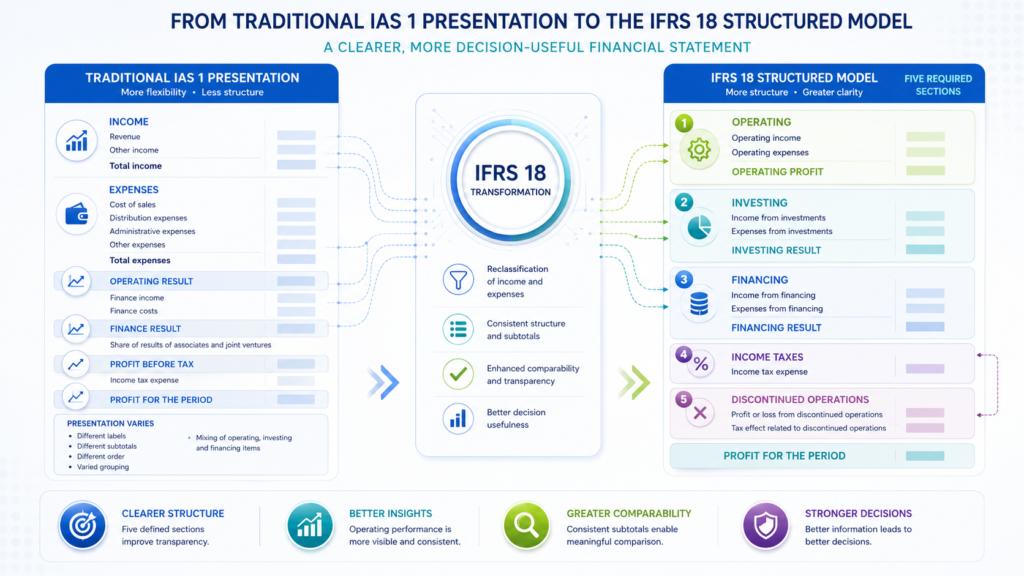
IFRS 18 changes the architecture of financial performance reporting. Effective for annual periods beginning on or after 1 January 2027, it replaces IAS 1 with a defined profit or loss structure, new disclosures for management-defined performance measures, and stronger aggregation and disaggregation rules. It is primarily a presentation and disclosure Standard, so the main impact is how performance is organised, labelled and explained.
What IFRS 18 changes and why it matters
IAS 1 allowed considerable flexibility over subtotals and classification, so similar entities could present different income statement structures. IFRS 18 responds with defined categories and common subtotals, while retaining room for additional line items when they provide a useful structured summary. Its three central changes concern profit or loss structure, management-defined performance measures, and grouping of information.
What moves from IAS 1 to IFRS 18, and what stays largely unchanged
Replacing IAS 1 does not mean rebuilding the complete set of financial statements. Many requirements continue with limited changes, either in IFRS 18 or after transfer to IAS 8 Basis of Preparation of Financial Statements or IFRS 7 Financial Instruments: Disclosures. The main operational change is the new profit or loss classification, which may require new chart of accounts and consolidation mappings.
The new structure of the statement of profit or loss
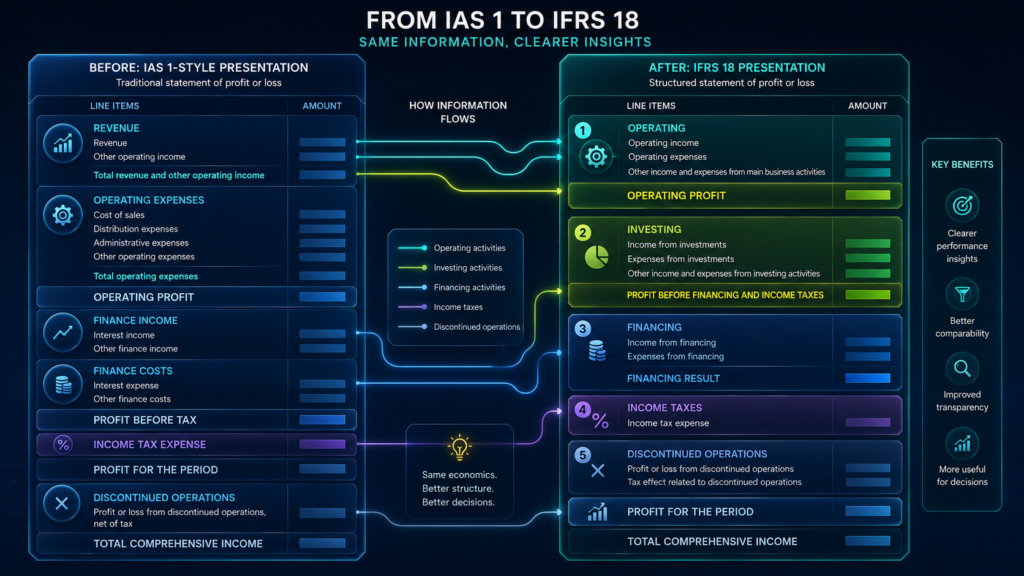
IFRS 18 requires five categories. Operating is the default and includes all items not classified elsewhere. Investing covers associates and joint ventures, cash and cash equivalents, and other assets that generate returns independently of the entity's other resources. Financing captures income and expenses from liabilities arising solely from raising finance, plus specified interest-related amounts on other liabilities. The income taxes category follows IAS 12, while the discontinued operations category follows IFRS 5.

The new required subtotals
Operating profit or loss comprises all items in the operating category. Profit or loss before financing and income taxes comprises operating profit plus the investing category.
These labels are defined. An existing subtotal called “operating profit” may therefore need to change. Additional subtotals remain possible when needed for a useful structured summary, but they must be faithfully labelled and consistently constructed.
The classification issues most likely to cause difficulty
Foreign exchange differences generally follow the category of the underlying item, although operating classification is permitted where tracing would involve undue cost or effort. Derivatives and designated hedging instruments follow specific rules linked to the item or risk managed. Equity-accounted associates and joint ventures remain investing. For liabilities not arising solely from raising finance, only specified interest and rate-change amounts move to financing. Broad legacy headings such as “finance income” and “other gains and losses” will often be too coarse.
Entities with specified main business activities
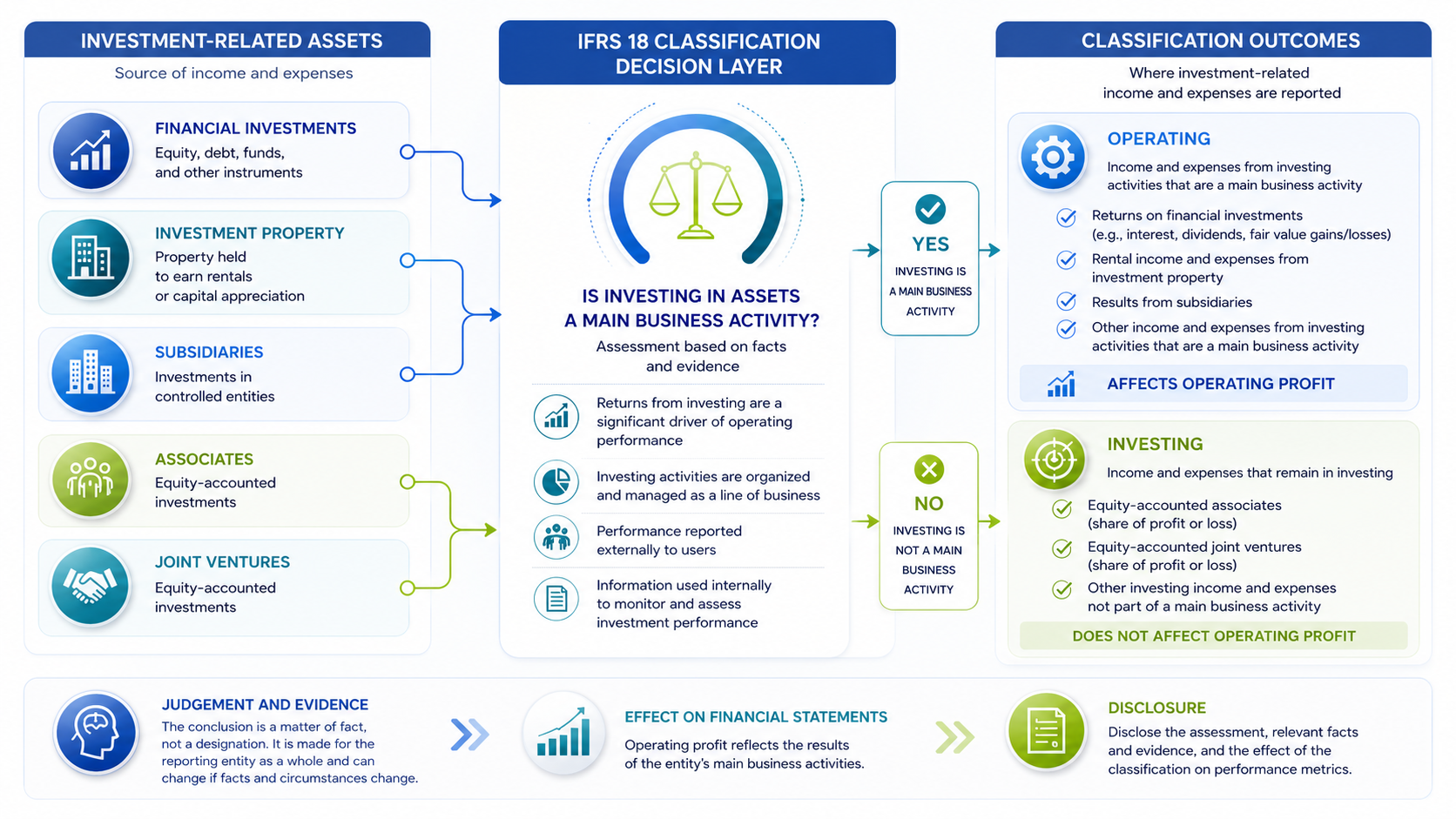
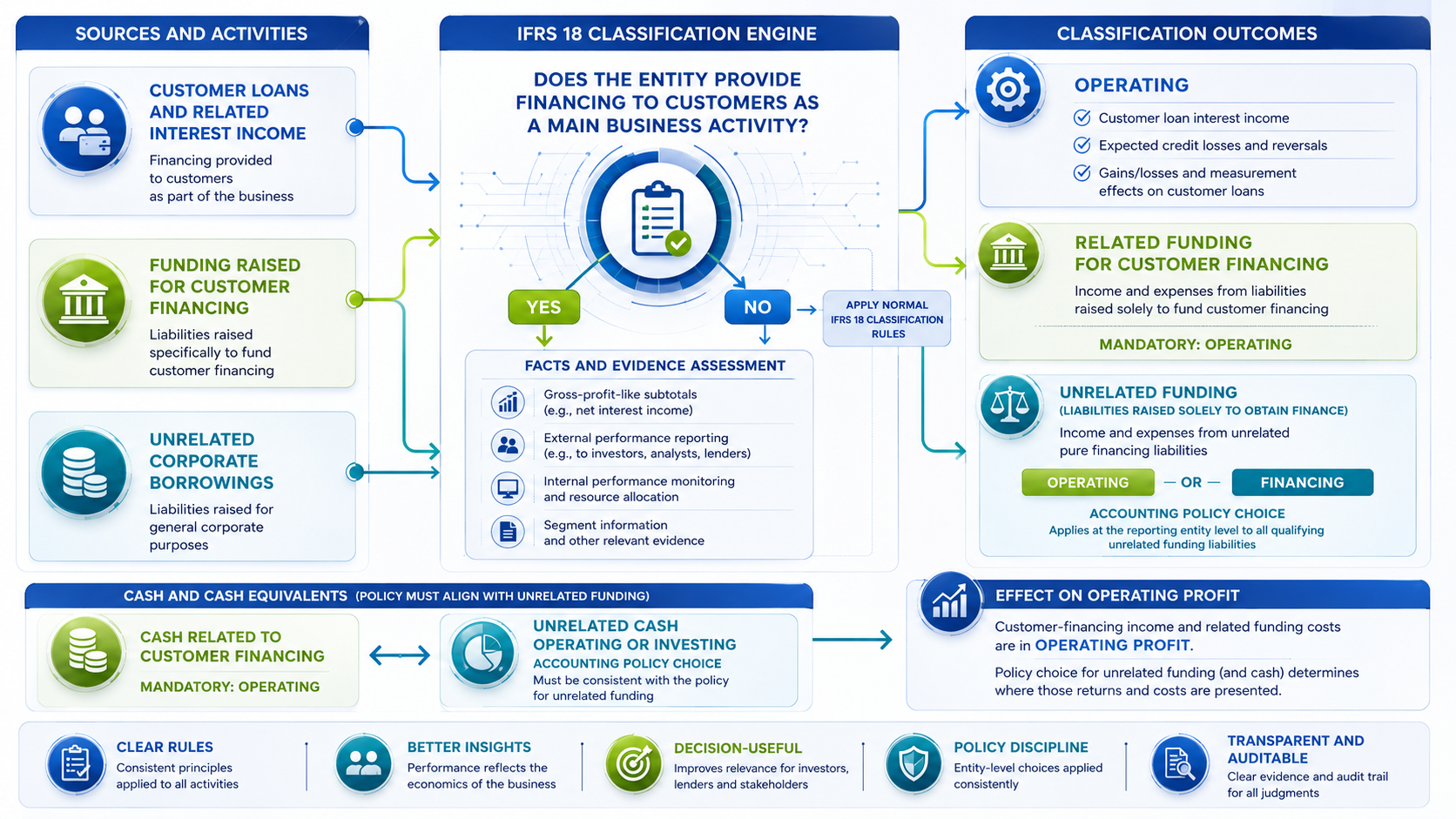
Having investments or borrowings does not make investing or financing a main business activity. The question is whether investing in particular assets or providing financing to customers is itself a main business activity. If so, related income and expenses that would otherwise be investing or financing can move to operating. Equity-accounted associates and joint ventures remain investing. For customer financing businesses, related funding costs are operating, while unrelated funding can be subject to an accounting policy choice between operating and financing, with linked consistency requirements.
Management-defined performance measures
An MPM must be a subtotal of income and expenses, used in public communications outside the financial statements, to communicate management’s view of an aspect of the entity’s financial performance as a whole. Adjusted profit measures may qualify. Free cash flow, net debt, return on equity, revenue measures and customer metrics do not. All MPM information sits in one note, including the calculation, purpose, reconciliation to the most directly comparable IFRS total or subtotal, tax and non-controlling interest effects, and changes in the measure.
Aggregation, disaggregation and the presentation of operating expenses
IFRS 18 requires aggregation of items with shared characteristics and disaggregation of materially different items. Material information must not disappear inside vague labels or excessive detail. Operating expenses may be presented by nature, function, or a mixed basis if that gives the most useful structured summary. Functional presentations also require note disclosure, by operating line item, of depreciation, amortisation, employee benefits, impairment losses and reversals, and inventory write-downs and reversals.
Changes beyond the statement of profit or loss
The main consequential changes affect IAS 7. Under the indirect method, operating profit becomes the required starting point. For most entities, interest and dividends paid are generally financing cash flows, while interest and dividends received are generally investing cash flows. IAS 33 restricts additional earnings-per-share numerators to IFRS 18 totals, subtotals or MPMs. IAS 34 brings relevant requirements into interim reporting.
IFRS 18 versus IAS 1: the key differences at a glance
- Profit or loss categories. IAS 1 did not prescribe the new five-category structure. IFRS 18 does.
- Required subtotals. IFRS 18 requires operating profit and, subject to specific exceptions, profit before financing and income taxes.
- Management measures. IFRS 18 requires qualifying measures to be explained and reconciled in one note.
- Aggregation and disaggregation. IFRS 18 adds more explicit principles on grouping, material detail and labelling.
- Operating expenses. IFRS 18 permits nature, function or a mixed presentation, with specified nature disclosures where function is used.
- Cash flows. Operating profit becomes the indirect-method starting point, and classification choices for interest and dividends narrow.
- Transition. IFRS 18 is retrospective, with a line-by-line reconciliation for the immediately preceding comparative period.
Worked example: from an IAS 1 presentation to IFRS 18
Consider a non-financial entity with revenue of CU1,000, operating expenses of CU780, investment income of CU20, share of profit from an equity-accounted associate of CU10, cash interest of CU5, borrowing costs of CU30 and net defined benefit interest of CU5. Under an IAS 1-style presentation, these items might sit across “other operating income”, “finance income” and administrative expenses. IFRS 18 moves CU35 to investing and CU35 to financing. Operating profit then contains operating items only, while profit before financing and income taxes adds the investing result before financing items are deducted.
Transition to IFRS 18
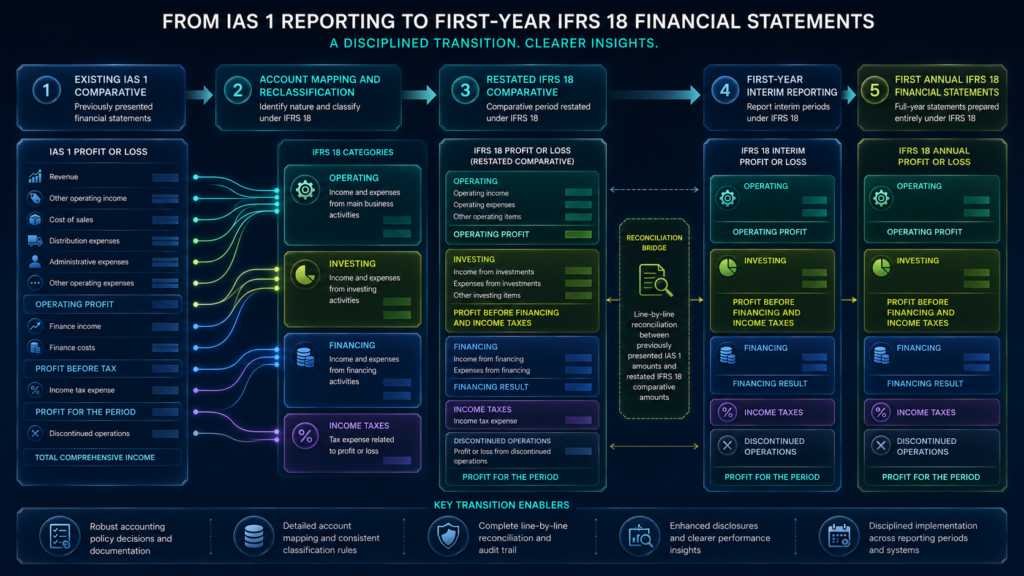
IFRS 18 is applied retrospectively under IAS 8. For the comparative period immediately preceding first application, annual financial statements must reconcile each profit or loss line item from the amount previously presented under IAS 1 to the restated IFRS 18 amount. First-year interim reports require corresponding comparative reconciliations. A transition bridge might split CU15 previously in “other operating income” into CU10 operating and CU5 investing, and CU6 in administrative expenses into CU5 operating and CU1 financing. First-time adopters follow IFRS 1 and use IFRS 18 presentation in their first IFRS financial statements and related interim reports.
Preparing for implementation
Implementation should begin with data, not formatting. The chart of accounts needs mapping to the five categories, with judgement-heavy items such as foreign exchange, derivatives, hybrid contracts and pension interest isolated. Public communications should be scanned for MPMs. Expense presentation, comparative data, consolidation rules, systems, controls, accounting policies and reporting packs all need to support the new structure. For an entity applying IFRS 18 on 1 January 2027 with one comparative year, the practical starting point is 1 January 2026.
Learn about our ACCOUNTING AND REPORTING services.
One Response
ufhkqgvggxskkjvqhklzlrxgggqvzq