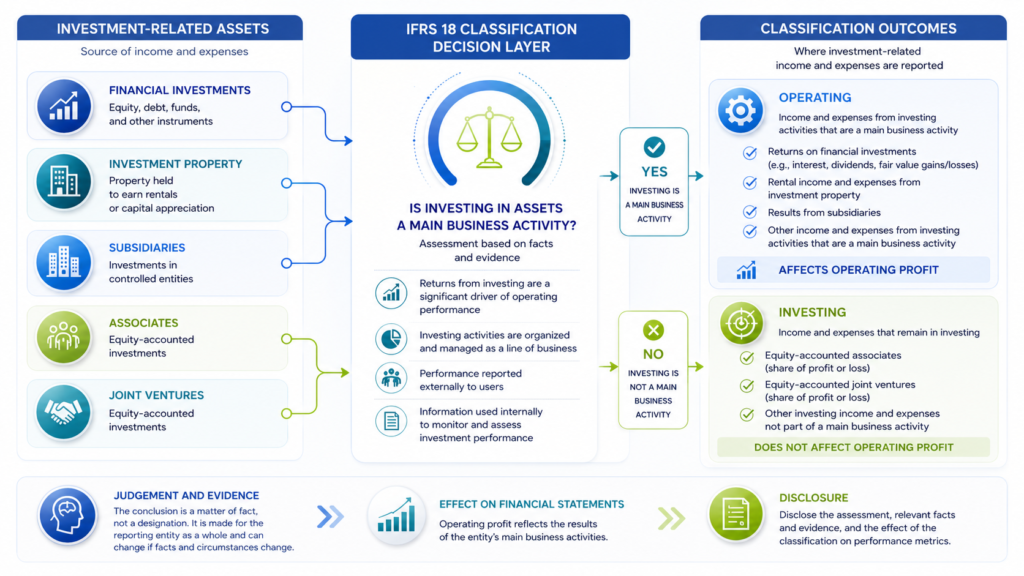
How the main business activity assessment changes classification, operating profit, and key investment-related income and expenses
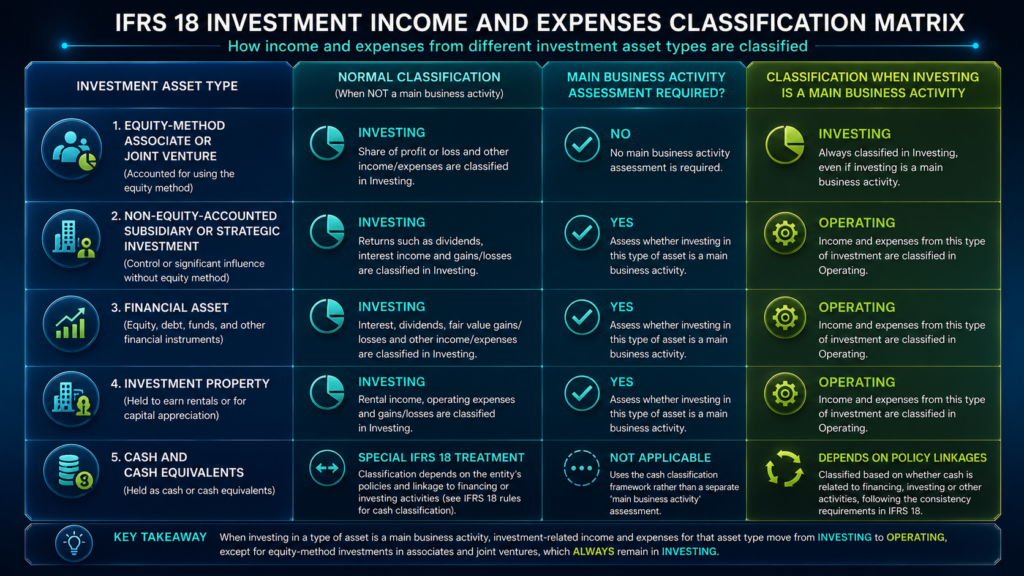
IFRS 18 does not place every investment return in the investing category. When investing in particular assets is a main business activity, related income and expenses can move into operating profit. Equity-method investments remain in investing.
Two entities holding similar assets may therefore classify the same return differently because those assets play different roles in their businesses. The assessment affects operating profit, account mapping and classification controls.
Having investments is not the same as investing as a main business activity
Most entities hold cash deposits, financial investments, investment property or strategic shareholdings. Those holdings do not, by themselves, create a specified main business activity.
The question is whether investing in the relevant asset type is itself one of the entity’s main business activities. An entity can have more than one. A conventional operating business may also have a main investment activity, while a large investment balance alone may still be insufficient.
How to determine whether investing is a main business activity
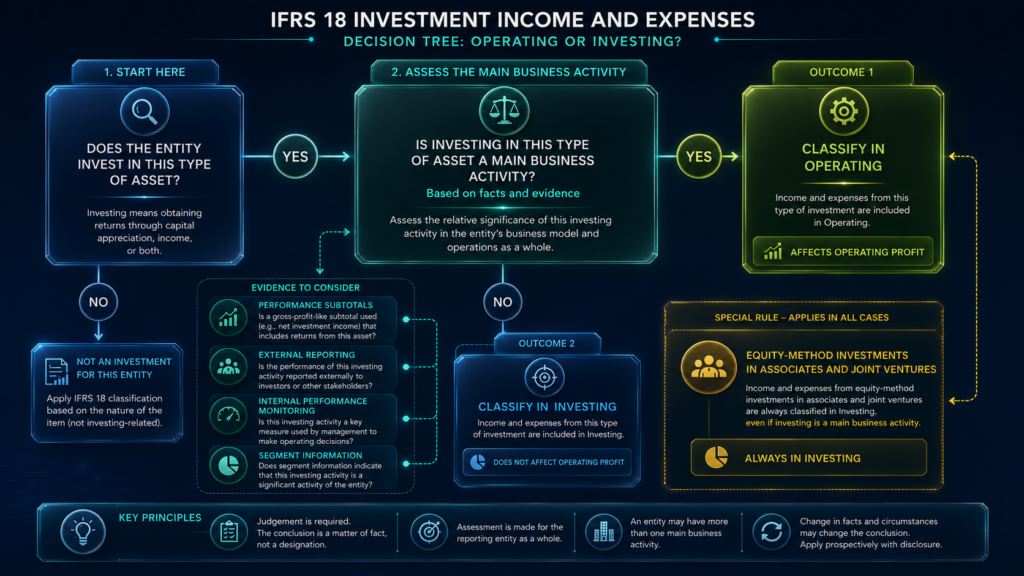
The conclusion is a matter of fact, not a label selected to produce a preferred operating profit. Judgement is required and must be supported by evidence.
Relevant evidence can include a gross-profit-like subtotal that incorporates investment returns and is treated as an important measure of operating performance. Segment information can also be persuasive. A reportable segment comprising a single business activity indicates that activity is a main business activity.
The assessment is made for the reporting entity as a whole.
Which entities are most likely to fall within the rules
IFRS 18 gives investment entities, investment property companies and insurers as examples. The list is not exhaustive.
A parent preparing separate financial statements can also qualify. A 2026 agenda decision concluded that a parent whose substantive activity was holding and managing investments in subsidiaries and distributing the returns had a main business activity of investing in unconsolidated subsidiaries. The absence of segment information or special performance subtotals did not prevent that conclusion.
Which assets are subject to the special assessment
The analysis separates three populations: investments in associates, joint ventures and unconsolidated subsidiaries; cash and cash equivalents; and other assets that generate returns individually and largely independently of the entity’s other resources.
The first group depends partly on the accounting method. Cash and cash equivalents are not themselves tested as a main business activity. Other independently returning assets are assessed individually or in groups.
Associates, joint ventures and unconsolidated subsidiaries
Income and expenses from investments accounted for using the equity method remain in investing, even where investing in those assets is a main business activity.
When an investment is not equity accounted, the result can change. An investment measured at cost or under IFRS 9 can produce operating-category income and expenses if investing in that asset type is a main business activity.
Other assets that generate independent returns
Financial investments and investment property are common examples. A factory normally works with other resources to produce goods or services. A bond can generate interest on its own, and investment property can generate rental returns largely independently of another business activity.
Without a specified main business activity, returns from these assets are investing. When investing in the relevant asset type is a main business activity, they move to operating.
What exactly moves from investing to operating
The reclassification is wider than dividends, interest or rent. It can include measurement gains and losses, fair value movements, impairment effects, derecognition or disposal results, and incremental expenses directly attributable to acquisition or disposal.
The special treatment of cash and cash equivalents
Cash and cash equivalents are not assessed independently as a main business activity. Where an entity invests in financial assets that generate independent returns as a main business activity, income and expenses from cash and cash equivalents are classified in operating.
A June 2026 tentative agenda decision takes the view that this applies to all cash and cash equivalents once the relevant financial-investment activity exists, even where some cash relates to another activity. Its status should be checked before publication.
Separate financial statements can produce a different answer
The assessment belongs to the reporting entity. A subsidiary, a parent’s separate financial statements and the consolidated group are different reporting entities, so conclusions can differ.
The 2026 agenda decision illustrates the point. The parent’s only substantive activity was holding and managing subsidiaries and distributing investment returns. Its separate financial statements therefore reflected a main business activity of investing in unconsolidated subsidiaries, although the consolidated group had not identified the same activity.
Worked example: how operating profit changes
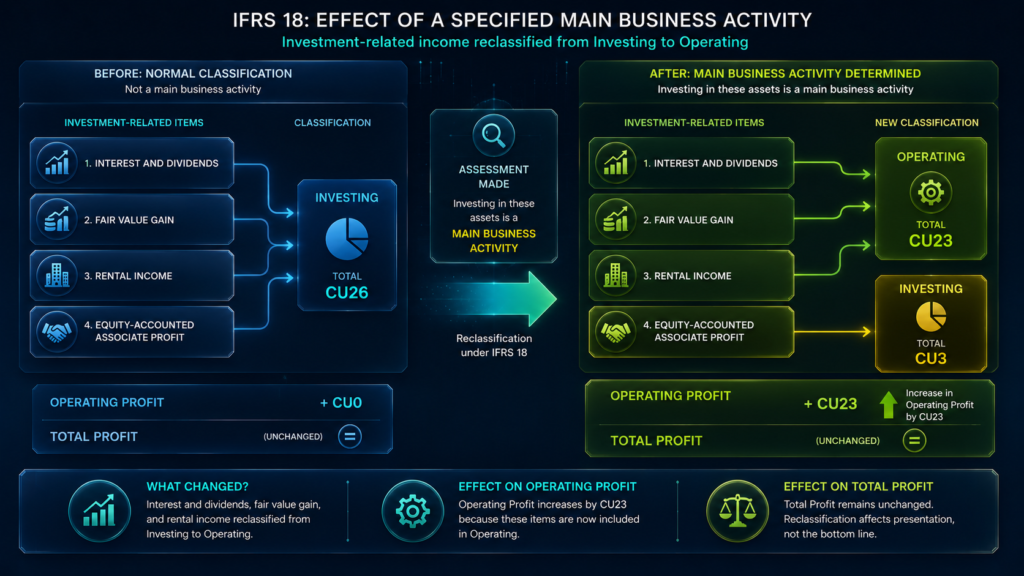
Consider an entity with a conventional operating business and a separate investment activity that qualifies as a main business activity. It earns CU12 of interest and dividends from managed financial assets, records a CU4 fair value gain, receives CU7 of rental income from investment property in the same activity, and reports a CU3 share of profit from an equity-accounted associate.
Without the specified main business activity rules, the CU26 total would be investing. Under IFRS 18, CU23 from the financial assets and investment property moves to operating. The CU3 equity-accounted share of profit remains in investing.
Operating profit increases by CU23. Total profit does not change.
Asset-by-asset or group assessment
IFRS 18 permits assessment for an individual asset or groups with shared characteristics. For financial assets, groups must be consistent with the classes identified under IFRS 7. For associates, joint ventures and unconsolidated subsidiaries in separate financial statements, grouped assessments must align with the IAS 27 measurement categories.
What happens when the assessment changes
A change in facts can change the outcome. The new conclusion is applied prospectively from the date of change. Previous assessments are not rewritten.
The entity discloses the change and its date. Unless impracticable, it also discloses the amount and classification of affected items before and after the change in the current period, together with corresponding prior-period information.
Practical implementation steps
Implementation begins by identifying investment populations and separating equity-method investments from other holdings. Remaining assets should be grouped consistently, with evidence for each main business activity conclusion documented.
Performance subtotals, external communications, internal reports and segment information should be reviewed together. Separate and consolidated financial statements need independent assessments. Mapping must extend beyond investment income to valuation movements, impairments, disposal results and directly attributable transaction costs.
Controls should identify changes in facts that could alter the assessment. Strong documentation will show why the activity is or is not a main business activity for the reporting entity concerned.
Learn about our ACCOUNTING AND REPORTING services.