
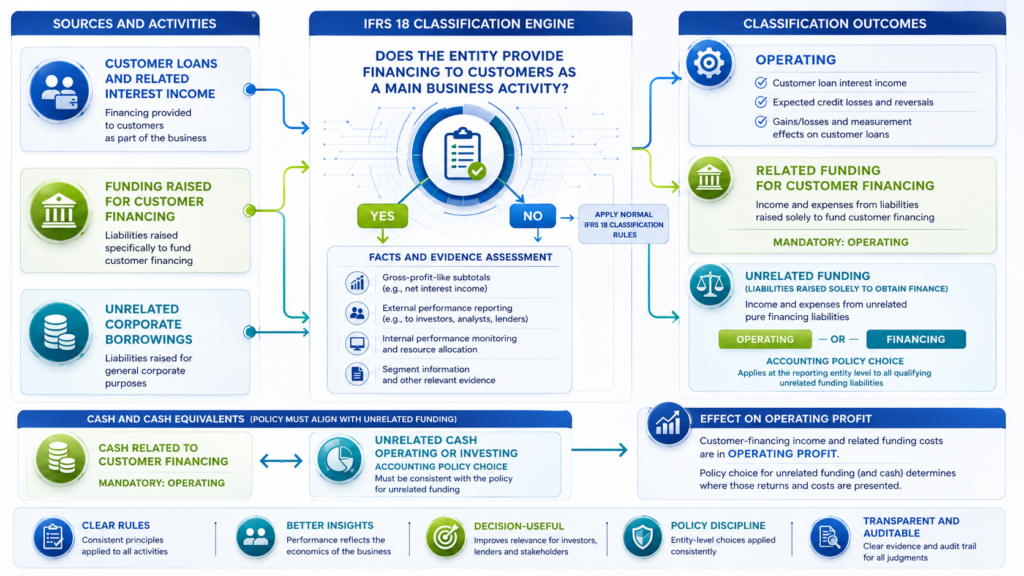
A technical guide to the special operating and financing classification rules for entities whose business includes financing customers.
Why the customer-financing assessment matters
IFRS 18 changes the location of income and expenses when providing financing to customers is a main business activity. Customer loans and their returns become part of operating performance. Funding costs linked to that activity can also move into operating. The statement of profit or loss therefore reflects the economics of earning a financing margin rather than splitting the asset return and related funding cost across different categories.
Expected credit losses, cash returns, foreign exchange differences, derivatives and different liability populations can all be affected.
What counts as providing financing to customers
IFRS 18 gives three examples: lending institutions, entities that finance customers so those customers can buy the entity’s products, and lessors that provide financing through finance leases. The examples are not exhaustive.
A June 2026 tentative agenda decision, open for comment until 9 September 2026, considered a manufacturer-lessor that managed finance and operating leases as one line of business and used a gross-profit-like subtotal for the aggregated lease activity. The tentative conclusion was that the aggregated activity was likely to be a main business activity of providing financing to customers. Operating-lease classification did not prevent that outcome.
The dividing line is factual. Financing must genuinely be one of the activities that drives operating performance.
How to determine whether customer financing is a main business activity
The conclusion is a matter of fact, not a designation chosen to produce a preferred operating profit. Judgement is required and must be based on evidence.
A gross-profit-like subtotal can be persuasive. Net interest income is an obvious example. Evidence is stronger when such a subtotal is used externally or to assess performance internally. Segment information can also support the conclusion.
The assessment is made for the reporting entity as a whole. A subsidiary can therefore reach a different conclusion from the consolidated group, and an entity can have more than one main business activity.
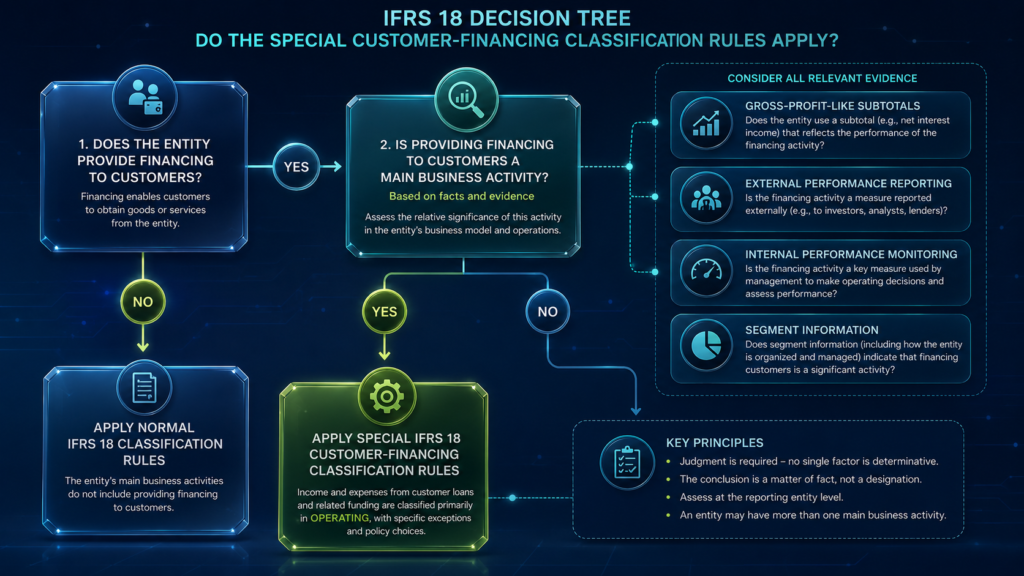
leading to the special IFRS 18 customer-financing classification rules or the normal classification rules.]
Customer loans and related income belong in operating
Once customer financing is a main business activity, loans to those customers are treated as assets used in the operating activity. Interest income, expected credit losses and reversals, derecognition gains and losses, and related measurement effects are operating.
The customer loan is not treated as an independent investment producing an investing return. It is part of the activity through which the entity earns its operating result.
The critical distinction between two types of liabilities
The liability analysis begins by separating liabilities into two populations. The first comprises liabilities arising from transactions that involve only the raising of finance, such as loans and bonds. The second comprises all other liabilities, including trade payables, contract liabilities, lease liabilities, defined benefit liabilities and provisions.
Providing financing to customers does not turn every interest expense into an operating item.
Funding that relates to providing financing to customers
For a liability arising solely from raising finance, the next question is whether it relates to providing financing to customers. If it does, the related income and expenses are operating.
The rule captures the economics of the financing margin. It also covers relevant measurement and derecognition effects, directly attributable issue or extinguishment costs, and certain derivatives related to pure financing transactions.
Funding that does not relate to customer financing
For pure financing liabilities that do not relate to customer financing, IFRS 18 permits an accounting policy choice. Related income and expenses can be classified either in operating or in financing.
If unrelated funding costs are classified in operating, the standard subtotal of profit before financing and income taxes is not presented. Another subtotal may be needed, but its label cannot imply that all financing amounts have been excluded.
A separate June 2026 tentative agenda decision, also open for comment until 9 September 2026, states that, for a consolidated reporting entity, the policy applies to qualifying unrelated funding liabilities across the group, not only those held by the customer-financing subsidiary.
What happens when related and unrelated funding cannot be distinguished
Centralised or pooled funding can make tracing difficult. If the entity cannot distinguish pure financing liabilities related to customer financing from unrelated funding, income and expenses from all such liabilities are classified in operating.
The June 2026 tentative agenda decision states that this outcome applies even when some liabilities can be traced but the complete population cannot be separated.
Other liabilities do not automatically move to operating
Liabilities that do not arise solely from raising finance remain subject to a different rule. Identified interest and interest-rate effects required by other Standards are financing. Other income and expenses from those liabilities are operating.
Interest on lease liabilities, net interest on defined benefit liabilities and the unwinding of discounted provisions illustrate the financing side of this boundary.
The special rules for cash and cash equivalents
If the entity does not also invest in financial assets as a main business activity, income and expenses from cash related to customer financing are operating. Returns on unrelated cash are subject to a policy choice between operating and investing, consistent with the policy for unrelated pure financing liabilities.
If related and unrelated cash cannot be distinguished, all cash income and expenses are operating. If the entity also invests in financial assets as a main business activity, all cash income and expenses are operating. A June 2026 tentative agenda decision, open for comment until 9 September 2026, confirms the latter outcome.
Cash and funding policies must work together
The consistency requirement can produce a wider effect. If inability to distinguish cash forces all cash returns into operating, the June 2026 tentative agenda decision states that income and expenses from pure financing liabilities must also be classified in operating, even when those liabilities can themselves be distinguished.
Treasury mapping can therefore determine the classification of a much larger liability population.
Consolidated groups create another layer of complexity
The assessment belongs to the reporting entity as a whole. If a consolidated group concludes that customer financing is a main business activity, the special rules operate at group level.
The June 2026 tentative agenda decision states that the policy choice for unrelated pure financing liabilities applies across the consolidated group. Corporate debt raised outside the financing subsidiary remains within the policy decision.
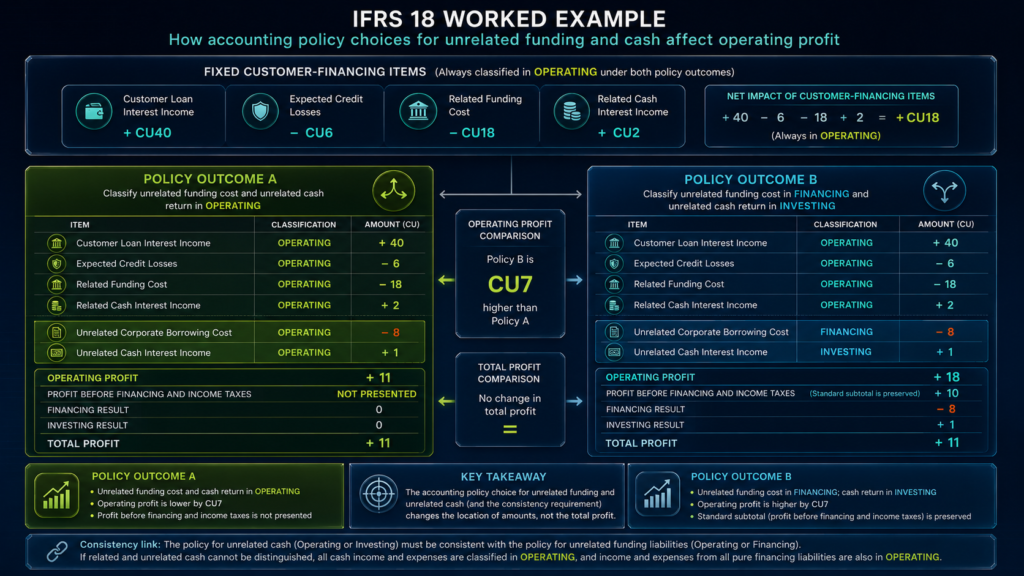
Worked example: related funding, unrelated funding and operating profit
Consider an entity with two main business activities: selling products and financing customers who buy them. It recognises CU40 of customer-loan interest income, CU6 of expected credit losses, CU18 of interest expense on related funding, CU8 of interest expense on unrelated corporate borrowing, CU2 of interest income on related cash, and CU1 of interest income on unrelated cash.
The customer-financing items are operating. The policy choice affects only the CU8 borrowing cost and CU1 unrelated cash return.
If both are classified in operating, both enter operating profit. If the borrowing cost is financing and the cash return investing, operating profit is CU7 higher because CU8 of cost leaves operating while CU1 of income also leaves. Total profit is unchanged. The second outcome preserves the standard profit before financing and income taxes subtotal; the first does not.
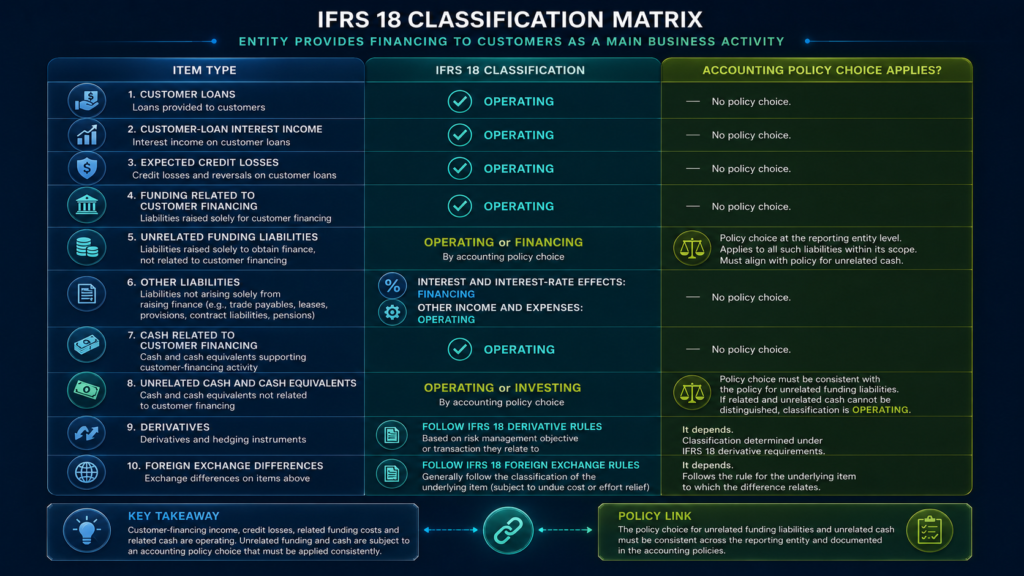
A practical classification matrix
The core outcomes are:
- Customer loans, interest income and expected credit losses. Operating.
- Pure financing liabilities related to customer financing. Operating.
- Pure financing liabilities unrelated to customer financing. Operating or Financing, by accounting policy choice.
- Other liabilities. Identified interest and interest-rate effects in Financing, with other income and expenses in Operating.
- Cash related to customer financing. Operating.
- Unrelated cash. Operating or Investing, consistently with unrelated funding.
- Foreign exchange differences and derivatives. Follow the specific IFRS 18 rules for the underlying item, managed risk or transaction.
What happens when the assessment changes
A change in facts can change the conclusion. The new outcome is applied prospectively from the date of change; earlier assessments are not rewritten.
The entity discloses the change and its date. Unless impracticable, it also provides quantitative information showing affected classifications before and after the change, together with corresponding prior-period information.
Practical implementation steps
Implementation starts with evidence for the main business activity conclusion, supported by performance subtotals, internal reporting, external communications and segment information where relevant.
A complete liability inventory is then required. Pure financing liabilities must be separated from other liabilities and traced to customer financing where possible. Cash balances need the same discipline because the cash and funding policies are linked. Derivatives and foreign exchange differences must be mapped back to the risks and items that drive their classification.
For groups, the analysis cannot stop at the financing subsidiary. Policy choices and inability-to-distinguish tests must be considered at the consolidated reporting-entity level. Controls also need to detect changes in business activities and treasury structures that could alter the classification outcome.
Learn about our ACCOUNTING AND REPORTING services.
One Response
pzkdzwwdzqfnttikystigxyqfhefrj