

Controlled deployment, clear boundaries and early team involvement can turn agentic AI into an operating improvement rather than a source of confusion.
AI agents can be technically capable and still fail operationally. Disruption usually begins when an agent is introduced with too much scope, vague authority or no clear place in the existing process.
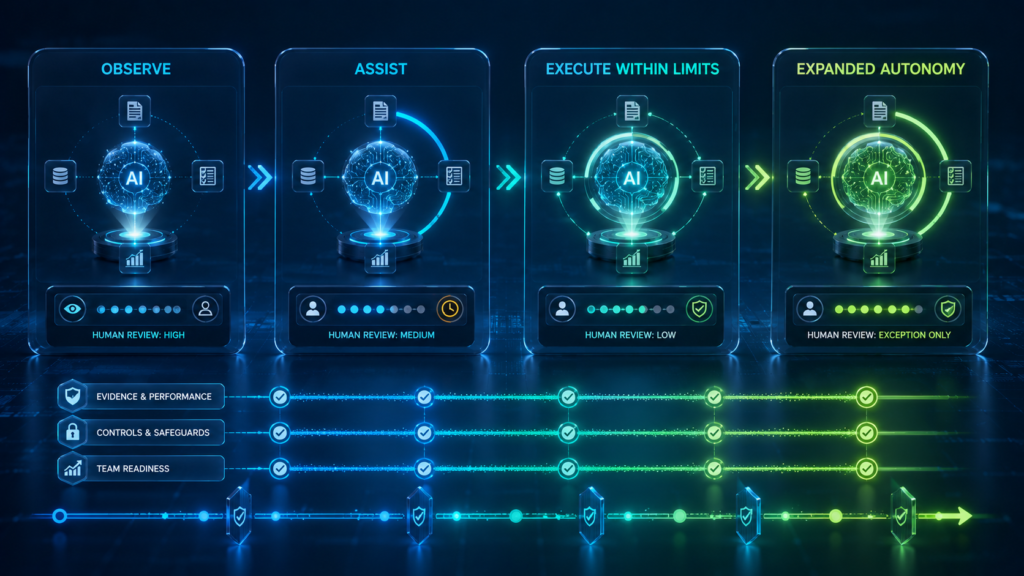
A safer approach is staged. Start with a bounded process, involve the people who run it, define what the agent may do, and keep human review until performance is stable. Autonomy should expand only after the operating model proves it can support it.
Why AI Agent Deployments Disrupt Teams
Most disruption is created by deployment choices rather than autonomy itself. A team may be told that an agent will “help with the process” without knowing which tasks will move, who will handle exceptions or who remains accountable.
Problems multiply when the first use case is too broad. An agent may be given access to several systems and responsibility for a process full of undocumented exceptions. The technology then becomes entangled with unresolved process design.
Start with a Process That Is Narrow Enough to Control
The first process should have a clear start and finish, known systems, manageable exceptions and enough volume to produce useful evidence. It should also have limited consequences if the agent fails.
An invoice exception process is a stronger pilot than “automate finance”. The agent can gather records, check defined conditions, request missing evidence and route unresolved cases. A bank reconciliation pilot can focus on investigating unmatched items rather than taking unrestricted action across the ledger.
The same principle applies elsewhere. A purchase request review can be bounded by policy and approval thresholds. Employee onboarding can be limited to approved coordination steps. A routine service request can be resolved only when a known remediation path exists.
A pilot that is too trivial proves little. A pilot where nearly every case is unique produces noise instead of evidence.
Involve the People Who Actually Run the Process
Documented procedures rarely contain the whole process. Frontline staff often know which data source is unreliable, which exception is common, which approval happens informally and which step only works because someone remembers to chase it.
Process owners and specialists should identify hidden workarounds, judgement points and failure conditions before deployment. Early involvement also makes the team part of process redesign rather than the recipient of a finished system imposed on existing work.
Define What the Agent Can Do Before Giving It Autonomy
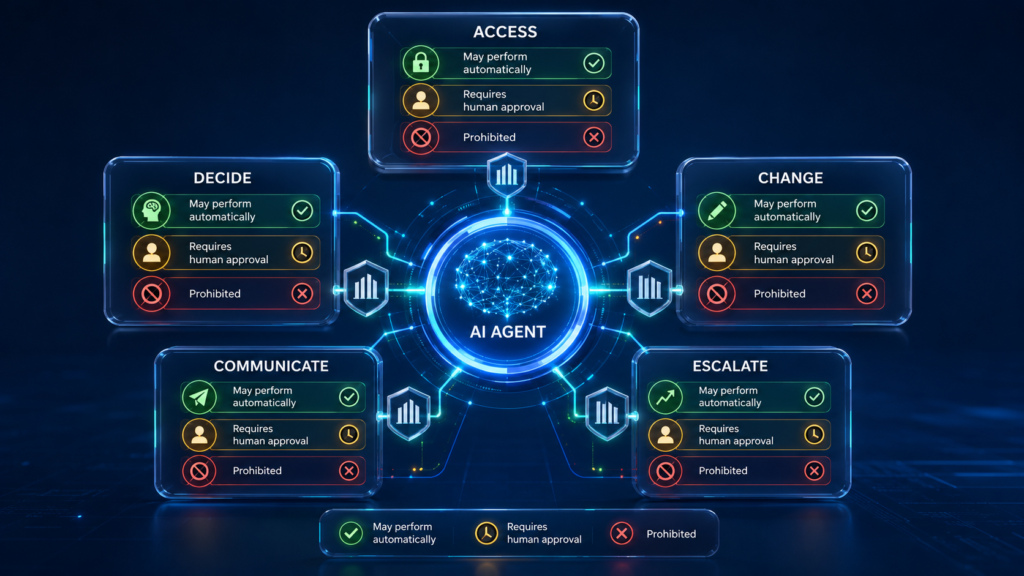
Authority should be explicit before the agent begins acting. The design should state what the agent may access, decide, change, approve and communicate. It should also define what must be escalated and when the agent must stop.
A supplier onboarding agent may collect information, check required documents and flag missing evidence, but not approve the supplier or change payment details. A user-access agent may execute standard changes within approved rules, while privileged access requires separate approval.
Where Agentic AI Is Reshaping Back-Office Work
In finance, an agent could reconcile records, investigate unmatched items, obtain support, prepare a proposed adjustment and route it for approval. In procurement, it could assess a request against policy, confirm supplier and contract status, follow up on missing information and monitor completion. In human resources, it could coordinate onboarding across documents, payroll, access and training. In information technology, it could classify a service request, inspect system information, apply an approved remediation, test the result and escalate with a documented history.
Across all four areas, the unit of automation expands from a task to an outcome.
The Technology Is Ready Before the Processes Are
The harder constraint may sit inside the operating environment rather than the AI. Autonomous execution depends on processes that are sufficiently understood to be delegated.
Fragmented systems create gaps in context. Inconsistent data creates conflicting signals. Undocumented exceptions force agents to infer rules the organisation itself has never made explicit. Unclear ownership leaves no reliable answer to a basic question: who is responsible when the process reaches a judgement point?
Manual work often hides these weaknesses because experienced employees compensate for them. They know which report is unreliable, which approval is informal and whom to call when the documented process fails. An autonomous agent exposes that operational knowledge problem.
Before a process can support meaningful autonomy, objectives, decision rights, data sources, exceptions, ownership and escalation paths need to be explicit.
The Human Role Moves from Processing to Supervision
As agents take on more execution, less time is spent moving information, checking routine conditions and chasing the next step. More attention moves toward setting objectives, defining boundaries, reviewing exceptions and judging outcomes.
This is not passive oversight. Human owners need to understand what an agent may do, where it must stop and how performance is monitored. The strongest model places routine execution with agents, exceptions with specialists and accountability with named people.
What This Means for Headcount and Roles
Transaction-heavy roles are likely to face the greatest redesign pressure because a larger share of their work consists of repeatable digital tasks. Research on AI exposure places clerical work among the most exposed categories, while also finding that job transformation is more likely than uniform elimination because most occupations still contain tasks requiring human input.
Where teams spend most of their capacity moving data, following up, checking standard conditions and routing work, fewer people may be required to process the same volume. Remaining roles will also change. More work will sit around exception handling, process ownership, control design, performance review and AI operations. A smaller processing team may need stronger subject-matter capability because the cases reaching people will be the cases the agent could not resolve.
Autonomy Requires Stronger Controls, Not Fewer Controls
Greater autonomy increases the importance of control design because an agent can act repeatedly and at speed. Access rights should be limited to what the process requires. Delegated authority should be explicit. Approval thresholds should determine when the agent can proceed and when a person must intervene.
Segregation of duties remains essential. An agent that can create a supplier should not also approve that supplier and release payment. An agent that prepares a journal should not automatically obtain unrestricted authority to post it. The control principle does not disappear because the actor is software.
Material actions should leave an audit trail showing what the agent did, what information it used, what permission allowed the action and when escalation occurred. Monitoring should cover output quality, security, compliance and human interaction.
Established frameworks point in the same direction. ISO/IEC 42001 covers responsibilities, data quality, lifecycle controls, performance evaluation, monitoring and continual improvement. The NIST AI Risk Management Framework similarly emphasises documented system limits, appropriate human oversight and post-deployment monitoring. Neither is limited to autonomous agents, but both provide a useful governance baseline.
The Real Opportunity Is Operating Model Redesign
The weakest deployment strategy is to place agents on top of broken processes and expect autonomy to repair them. An agent connected to fragmented systems, poor data and unclear authority can execute confusion faster.
The larger opportunity is to redesign back-office work around outcomes. That means deciding which objectives can be delegated, which decisions can be automated, which controls must remain independent, which exceptions need specialist judgement and who remains accountable for the result.
When those elements are designed together, agentic AI becomes part of a different operating model: machines execute more of the routine journey while people govern the boundaries, resolve difficult cases and own the consequences.
Learn about our AGENTIC AI services.